There are plenty of kitchen additions that look good in a photograph but do very little once they are in the room. A butcher’s block is not one of them.
A proper freestanding butcher’s block earns its space. It gives you another work surface, somewhere to prepare food, extra storage underneath and, in some cases, the option to move it where it is needed. It is one of the simplest ways to make a kitchen more useful without pulling out fitted units or taking on a major refit.
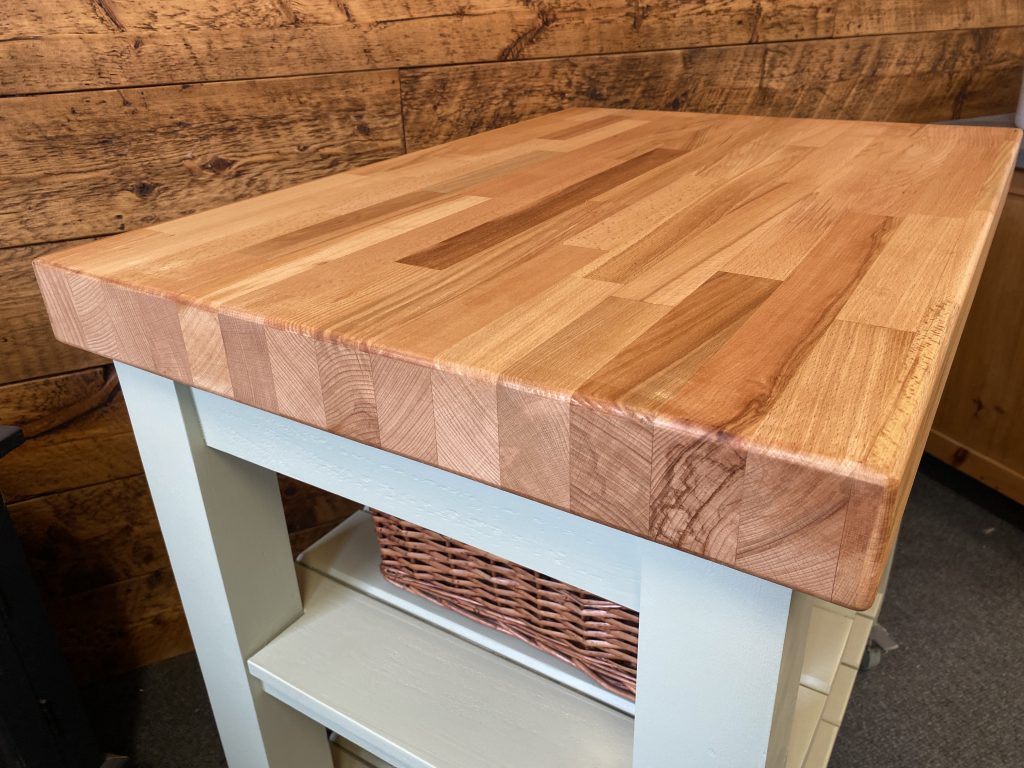
At Winkleigh Timber, our butcher’s blocks are handmade from reclaimed pine and finished with a beech top. They are solid, practical pieces designed for working kitchens, not just for display.
What is a butcher’s block?
Traditionally, a butcher’s block was a thick timber surface used for chopping and preparing food. The name has stuck, but the modern version has become a flexible piece of kitchen furniture.
A butcher’s block can sit against a wall as a permanent preparation area, stand beside a cooker as a place to put hot pans and ingredients, or work as a compact kitchen island. Some are fitted with castors, which makes them useful in a kitchen that needs to work hard at different times of day.
It is a good answer for homes with limited worktop space. Older properties often have kitchens with awkward corners, narrow runs of cabinetry or limited room for a built-in island. A freestanding block can give you extra working space without turning the whole room upside down.
Why reclaimed pine and beech make sense
Our butcher’s blocks are made from reclaimed pine, which gives each one character and avoids the overly uniform look of mass-produced furniture. Reclaimed timber has natural marks, grain variation and the sort of small details that make a piece feel established from the start.
The tops are made from beech and finished with tung oil for food preparation. Beech is a hard, close-grained timber that has long been used for kitchen work surfaces. It is durable, smooth and practical for chopping, rolling and general food preparation.
That combination works well in a kitchen. The reclaimed pine base gives the furniture warmth and personality, while the beech top provides a tough, usable surface where it matters most.
Our standard butcher’s block is around 915mm high, 615mm wide and 600mm deep. It is large enough to be genuinely useful without taking over most kitchens.
Where should a butcher’s block go?
Placement matters more than people think.
A block positioned near the cooker gives you a useful place for ingredients, pans and serving dishes. Near the fridge, it becomes a natural preparation point. In a utility room, it can create a working surface for laundry, flower arranging or household jobs.
Leave enough room around it to move freely. A kitchen can quickly become frustrating if people cannot pass each other or open a cupboard door while someone is using the block.
For smaller rooms, placing it against a wall is often the best route. In a larger kitchen, a freestanding block can take the place of a full island, providing worktop space without the permanence or cost of fitted cabinetry.
A model with castors is particularly useful where the kitchen has more than one job. It can be moved closer to the dining area when serving food, tucked away after use or brought out for larger family meals.
Storage that is actually useful
The best kitchen furniture does more than one job. A butcher’s block gives you a worktop, but the lower shelves can be just as valuable.
Use them for baskets of potatoes and onions, mixing bowls, cookbooks, pans, chopping boards or serving dishes. Open storage makes everyday items easy to grab, but it does need a little discipline. Keep it to useful things rather than turning it into a landing spot for post, chargers and half-empty packets.
You can also use the shelf space to introduce a little colour. A few woven baskets, ceramic bowls or neatly stacked linens can make the block feel part of the room without stopping it from being practical.
Looking after a timber work surface
Timber tops are meant to be used, so a few small marks over time are normal. That is part of the appeal.
Wipe spills promptly, particularly water, wine and strongly coloured foods. Avoid leaving wet cloths or pans sitting on the surface for long periods. Use a mild cleaner for day-to-day care and follow the supplied guidance on re-oiling the worktop when needed.
Tung oil helps protect the beech surface and makes it easier to wipe clean. It is still sensible to use a board for heavy chopping and to avoid harsh chemical sprays.
A useful piece that will not date
A butcher’s block works because it solves a real kitchen problem. It adds preparation space, storage and a solid furniture piece that can be moved, reused and enjoyed for years.
At Winkleigh Timber, our blocks are delivered as one solid piece, ready to use. Choose a polished or painted finish, with or without castors, and give your kitchen a work surface that feels like it belongs there.
FAQs
What is the best wood for a butcher’s block top?
Beech is a strong, close-grained hardwood that is well suited to kitchen preparation surfaces.
Can a butcher’s block be used as a small kitchen island?
Yes. A freestanding butcher’s block is a good compact alternative to a fitted island, particularly where extra preparation space is needed.
How do I protect a wooden butcher’s block worktop?
Wipe spills quickly, avoid leaving standing water on the surface and re-oil the top when required using a suitable food-safe oil.
Are butcher’s blocks suitable for small kitchens?
They can be. A compact block placed against a wall can add valuable worktop and storage space without the scale of a full island.
Are Winkleigh Timber butcher’s blocks delivered assembled?
Yes. They are delivered as a complete solid piece of furniture, ready for use once positioned in your kitchen.